Custom tablecloths print best from a vector logo file, placed in the upper-middle of the front panel, with strong contrast against the cloth color and very little extra text. Get Custom Tablecloths turns that artwork into a free mockup within 24 hours, so the file, placement and color choices you make before ordering decide how the finished linen looks.
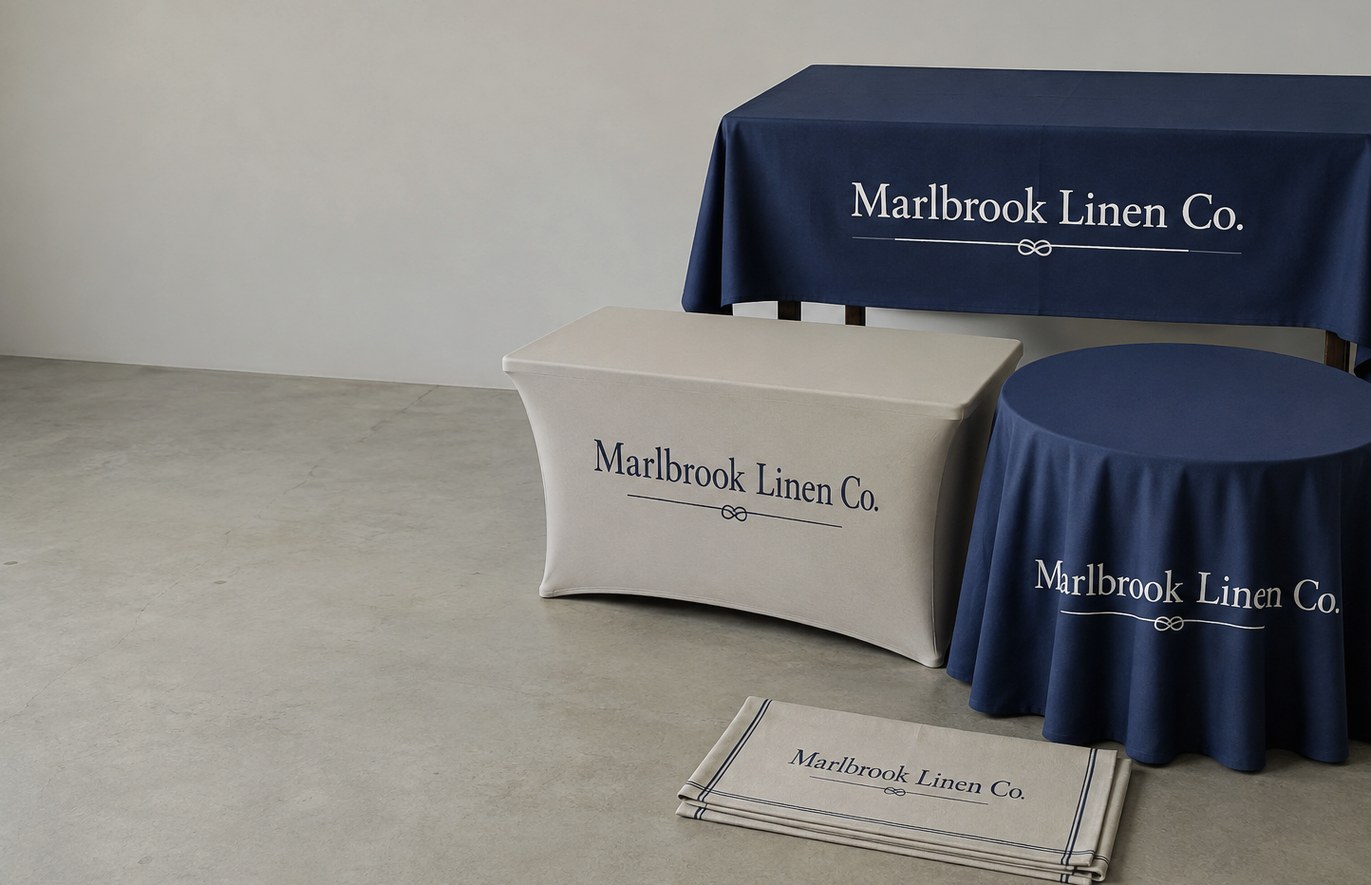
- Vector files (AI, EPS, SVG or editable PDF) scale cleanly across a full front panel.
- The front panel is the main print area; top, sides and back are optional.
- Dark cloths usually need a reversed white or light logo.
- Free mockup within 24 hours, unlimited free revisions, pay nothing until you approve.
- Standard production takes about 2 weeks after approval.
What artwork file should you send for custom tablecloths?
Send a vector file of your logo for custom tablecloths whenever you have one: an AI, EPS, SVG or a PDF exported from design software with the artwork still editable. Vector artwork is built from shapes rather than pixels, so Get Custom Tablecloths can scale it across a full front panel of a fitted throw or a draped banquet cloth without blurring or jagged edges.
A tablecloth is one of the largest surfaces your logo will ever be printed on. A file that looks sharp in an email signature or on a business card can fall apart when it is enlarged to span the front of a table, because a small raster image simply does not hold enough detail. That is the single most common reason a tablecloth mockup comes back with a note asking for a cleaner file.
- Best: the original vector file from whoever designed your logo, with fonts converted to outlines.
- Workable: a large, high-resolution PNG or PDF, especially for photographic or full-color artwork.
- Avoid: screenshots, logos copied from a website header, social media profile images and files that have been compressed and resent many times.
If you are not sure what you have, attach everything you can find to the quote form. The team will tell you which file works and flag anything that will not print cleanly at tablecloth scale before the mockup is finalized.
Where does the logo go on a custom tablecloth?
The front drop is the main print area on almost every custom tablecloth, because it is the panel visitors see as they walk toward the table. The top surface, side panels and back are secondary areas, and which of them make sense depends on the style you order and how the table will actually be used.
Think about what will be sitting on and around the table. At a trade show booth, brochures, a monitor or product samples often cover most of the tabletop, so a logo printed on the top may never be seen. At a registration desk, staff chairs and legs sit behind the cloth, so the back panel rarely matters. At a cocktail reception, guests circle the table, which is why round and cocktail covers often carry the design all the way around.
| Style | Primary print area | Worth considering |
|---|---|---|
| Fitted table throw | Front panel | Side panels for booths visible from an aisle corner |
| Stretch spandex cover | Front panel | Top surface when the table stays clear |
| Draped banquet cloth | Front drop | A centered top mark for seated dinners |
| Round and cocktail cover | Wraparound or repeated logo | Two placements so every side reads |
Tell the team how the table will be dressed on the day, and the mockup will place the artwork where people will actually see it.
How do brand colors behave on tablecloth fabric?
Brand colors on custom tablecloths depend on two things: the base color of the fabric and the print method. Get Custom Tablecloths shows your colors on the mockup against the cloth color you choose, so you can judge contrast before anything is produced rather than after the linen arrives.
Fabric is not paper. Polyester tablecloth fabric has a woven texture and a slight sheen, so colors can read a touch softer or deeper than they do on a backlit screen. If you have Pantone references for your brand, include them with your artwork; they give the production team a fixed target instead of a guess based on a monitor. If you only have screen colors, say so, and the mockup will be your reference point.
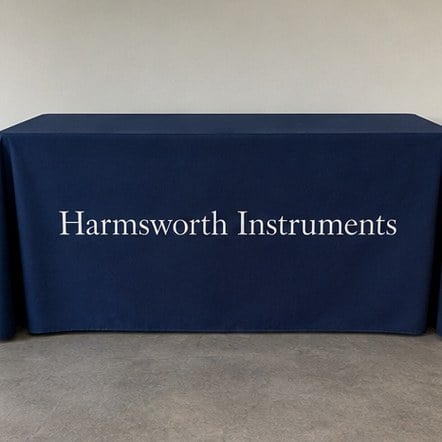
The cloth color itself is a design decision. A black or navy tablecloth hides scuffs and looks formal, but a dark logo will disappear on it. Most brands handle this with a reversed version of the logo: white or light artwork that keeps the same shape. If your brand guide includes a reversed logo, send it alongside the standard one.
- Match the cloth to your booth backwall or event palette, not only to the logo.
- Check that thin light elements stay visible on dark fabric.
- Ask for a full-color, edge-to-edge design through dye-sublimation when the background itself is part of the brand.
How big should the logo and text be on a tablecloth?
The logo on a custom tablecloth should be large enough to read from across a room or down an exhibit aisle, which usually means bigger than first-time buyers expect. A tablecloth works like a sign at waist height: people glance at it while walking, so the brand name has to register in a second or two.
Keep the message short. One logo, and at most one line of supporting text such as a tagline or website, is easier to read than a paragraph of services. Long lists of products, phone numbers and social handles crowd the front panel and shrink everything to a size nobody can read from a distance.
Watch the lower edge and the corners. On a floor-length fitted throw or draped cloth, anything printed near the hem may be hidden by chairs, boxes or a carpet edge, and artwork near a fold can bend out of sight. Placing the logo in the upper-middle part of the front panel keeps it above table clutter and at the eye line of people walking past.
Fine details deserve extra care. Hairline outlines, tiny trademark symbols and thin script fonts can soften on textured fabric. The mockup is the place to check whether those elements still read, and to ask for a bolder version if they do not.
What should you check on the free tablecloth mockup before approving?
Check the free tablecloth mockup for spelling, logo version, colors, placement and the exact style and size before you approve it. Get Custom Tablecloths returns the mockup within 24 hours, offers unlimited free revisions and charges nothing until you approve, so it costs you nothing to send it back with corrections.
- Text: read every word aloud, including the website address, tagline and any event name.
- Logo version: confirm it is the current logo, not an older version still saved on a shared drive.
- Contrast: look at the artwork against the cloth color, not against a white page.
- Placement: confirm the front panel, top and sides match how the table will be dressed.
- Style and size: confirm fitted, stretch, draped, cocktail or runner, and the table size, for every line on the order.
- Back panel: confirm open or closed back on throws and draped cloths.
- Approvals: share the mockup with whoever owns the brand before you sign off.
Most problems a buyer discovers at the event could have been caught here. Five minutes spent on this list saves a reprint.
What are the most common tablecloth artwork mistakes?
The most common tablecloth artwork mistakes are low-resolution files, logos that vanish against the cloth color and artwork placed where the table setup will hide it. Each is easy to fix before production and expensive to fix after, which is why Get Custom Tablecloths flags them at the mockup stage.
- A web logo stretched to fit: a small image pulled from a website header looks soft and pixelated across a full front panel.
- Dark on dark: a navy logo on a black cloth, or a gray tagline on charcoal, reads well on screen and poorly in a dim venue.
- Too much copy: service lists, addresses and several social handles shrink the logo and slow the reader down.
- Dates on evergreen linen: printing this year’s event date on a cloth you plan to reuse ends its life after one season. A printed runner or topper can carry dated messages instead.
- Hem-level artwork: anything near the bottom edge disappears behind chairs and boxes.
- Unoutlined fonts: a file sent with live fonts can substitute a different typeface if the font is missing.
How does the artwork step fit into your tablecloth order timeline?
The artwork step is the only part of a custom tablecloth order you fully control, so it is where most schedules are won or lost. Get Custom Tablecloths returns a free mockup within 24 hours of receiving usable artwork, and standard production takes about 2 weeks after you approve, with faster turnaround available through express shipping.
The clock that matters starts at approval, not at the first email. If you send a low-resolution file, wait for a better one from a designer, then route the mockup through three people, a week can pass before production begins. Sending a clean vector file, your brand colors and a clear table list on day one removes most of that delay.
Approved artwork stays on file, which makes the next order simpler. When a new office opens or a second booth team needs its own set, the reorder can go straight to production without repeating design work. Organizations that run many events, such as the congregations described on the church and faith community tablecloths page, benefit from getting the master file right the first time. Learn more on how it works.
Frequently asked questions
Can I send a logo copied from my website for a custom tablecloth?
A logo copied from a website is usually too small for custom tablecloths, because web images are sized for screens rather than a full front panel. Enlarged across a fitted throw or draped cloth, the edges turn soft and pixelated. Get Custom Tablecloths will flag a file like this at the mockup stage, so ask your designer for the original vector version before you order.
Can a tablecloth logo go on the top surface instead of the front?
Custom tablecloths can carry a logo on the top surface, though the front panel stays the most visible spot for most events. A top print works on tables that stay clear, such as a seated dinner or a stretch cover at a cocktail reception. At a busy trade show booth, brochures and displays often hide the top, so most buyers keep the main logo on the front.
Should I use a reversed white logo on a dark tablecloth?
A reversed logo is usually the right choice for a black, navy or charcoal custom tablecloth. A dark logo printed on dark fabric loses contrast and becomes hard to read in a dim ballroom or exhibit hall. Send both your standard and reversed versions to Get Custom Tablecloths, and the free mockup will show which reads better on the cloth color you chose.
Can I print on the side panels of a fitted tablecloth too?
Side panels on a fitted custom tablecloth can carry artwork alongside the front panel. Side prints help when a booth sits on an aisle corner or when visitors approach the table from more than one direction. Mention every panel you want printed in your quote request, and the mockup will show how the front and side designs line up at the corners.
Do I need to convert fonts to outlines in tablecloth artwork?
Converting fonts to outlines is the safest way to send text for custom tablecloths. A file with live fonts can display a substitute typeface if the font is missing on another computer, which quietly changes the look of your brand. Outlined text keeps the exact letterforms. If you cannot outline the file yourself, name the fonts used so Get Custom Tablecloths can check them.
How much text is too much on a custom tablecloth front panel?
Custom tablecloths read best with one logo and no more than one short line of supporting text, such as a tagline or website. People glance at a table while walking past, so lists of services, addresses and several social handles shrink everything and slow the reader down. Put detailed information on brochures or signage and let the tablecloth carry the brand.
Can I put a website address or QR code on a tablecloth?
A website address or QR code can be printed on custom tablecloths, and both work best as a secondary element below the main logo. Keep a QR code large enough to scan from a short distance and test it on the mockup before approval. Get Custom Tablecloths shows the exact placement in the free mockup so you can confirm it stays above table clutter.
How do I keep a tablecloth logo from being hidden by chairs or displays?
Keeping the logo in the upper-middle part of the front panel protects custom tablecloths from being blocked by chairs, boxes and display stands. Artwork near the hem of a floor-length throw or draped cloth often disappears once the table is set up. Tell Get Custom Tablecloths what will sit on and around the table, and the mockup will place the design where people can see it.
What happens to thin lines and small type when printed on tablecloth fabric?
Thin lines and very small type can soften on custom tablecloths because polyester fabric has a woven texture rather than a smooth paper surface. Hairline outlines, tiny trademark marks and delicate script fonts are the elements most likely to lose definition. Get Custom Tablecloths will point out details at risk on the mockup, and a slightly bolder version usually fixes the problem.
Can I ask for changes after I see my tablecloth mockup?
Changes to a custom tablecloth mockup are expected, and Get Custom Tablecloths offers unlimited free revisions before you approve. You can adjust logo size, placement, colors, cloth color or text as many times as needed. Nothing goes to production and you pay nothing until you sign off, so use the revision rounds to get every detail right before the order is printed.
Should my tablecloth background color match my logo or my booth?
A custom tablecloth background color should usually match your booth, backwall or event palette first, then provide enough contrast for the logo. A cloth that blends with the rest of your display makes the whole setup look planned, while strong contrast keeps the logo readable. Get Custom Tablecloths can show the same artwork on more than one cloth color in the mockup.
Will my approved tablecloth artwork be kept for future orders?
Approved artwork for custom tablecloths stays on file with Get Custom Tablecloths, so a future order can reuse the same design without starting from scratch. That helps when a new location, a second sales team or a replacement set needs identical linen. Note the exact style, size and cloth color of your first order so the reorder matches it, then follow the standard turnaround of about 2 weeks.
Get a free mockup for your tablecloths
Send your logo or idea and the quantity you have in mind. Get Custom Tablecloths returns a free mockup within 24 hours, you approve the design before anything is produced, and standard turnaround is about two weeks with faster options available. Get a custom quote.