Two booths at the same show can run the same logo on their table and still look a class apart, and the reason is usually the cover style rather than the print. A loose throw, a tailored fitted cover, and a form-hugging stretch cover read very differently across an aisle, fit different tables, and cost different amounts. Picking the wrong one means either fabric pooling on the floor or a cover that will not go over your table at all. Here is how the three styles differ and how to match one to your table and your booth.
The three cover styles at a glance
The throw, sometimes called a draped or economy cover, is a single panel that lays over the table and drapes toward the floor. It is the most affordable style and the most forgiving of slight size differences, so one throw can work across 4, 6, and 8 foot tables. The trade-off is a looser look, with excess fabric that can bunch at the corners and pool on the floor. The fitted cover is sewn to a box shape with tailored corners and sharp vertical edges, giving a clean, professional line and no loose fabric, but it is cut for one specific table size and will not interchange. The stretch cover, made from a spandex-blend fabric, pulls taut over the table and legs for a sleek, modern, wrinkle-free finish; it is the premium option, and because the fabric is under tension, a printed design cannot cleanly cross the seam lines. A printed table runner is a useful companion to any of the three: laid across a solid or lightly branded base cover, it adds a second graphic surface and lets you refresh messaging for a new show without reordering the whole cover.
Open back or closed back: the decision people forget
Independently of style, most covers come in a three-sided (open back) or four-sided (closed back) configuration, and this choice matters as much as the style. An open back leaves the rear panel off, so your staff can sit behind the table, tuck their legs under, and store boxes and cases out of sight beneath it. That is the right pick when the table sits against a booth wall and only three sides ever face the public. A closed back wraps all four sides and fully encloses the table, which you want when the table stands as a freestanding island that attendees can walk around, or when you want everything underneath completely hidden. Throw and fitted styles offer both backs; stretch covers are typically open-back by design. Decide this based on where the table physically sits in the booth, not on looks alone.
Match the style to the table and the booth
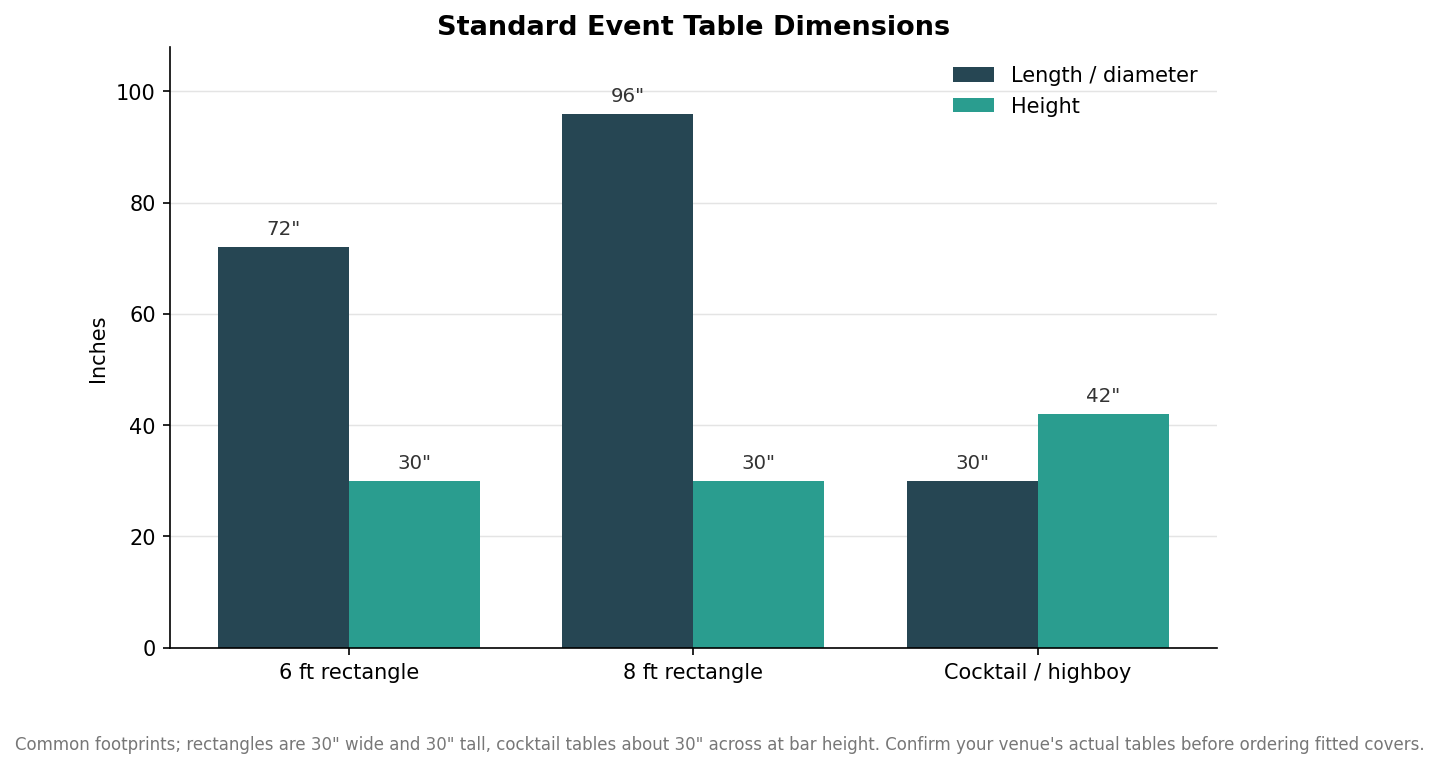
Fitted and stretch covers are cut to a specific table, so you have to know the exact table before you order. The two rectangular sizes that dominate trade shows are the 6 foot table at 72 by 30 by 30 inches and the 8 foot table at 96 by 30 by 30 inches; cocktail or highboy tables are round, roughly 30 inches across and 42 inches tall at bar height. The chart below lays these out so you can confirm which cover size you actually need.
If you travel to venues that supply different tables, a throw is the safer buy because it tolerates small size differences, while a fitted or stretch cover locks you to one footprint. When you control the table, or always rent the same size, the tailored styles reward you with a sharper look. Convertible throws that adjust between 6 and 8 feet exist as a middle path if you regularly face both.
Fabric weight, printing and care
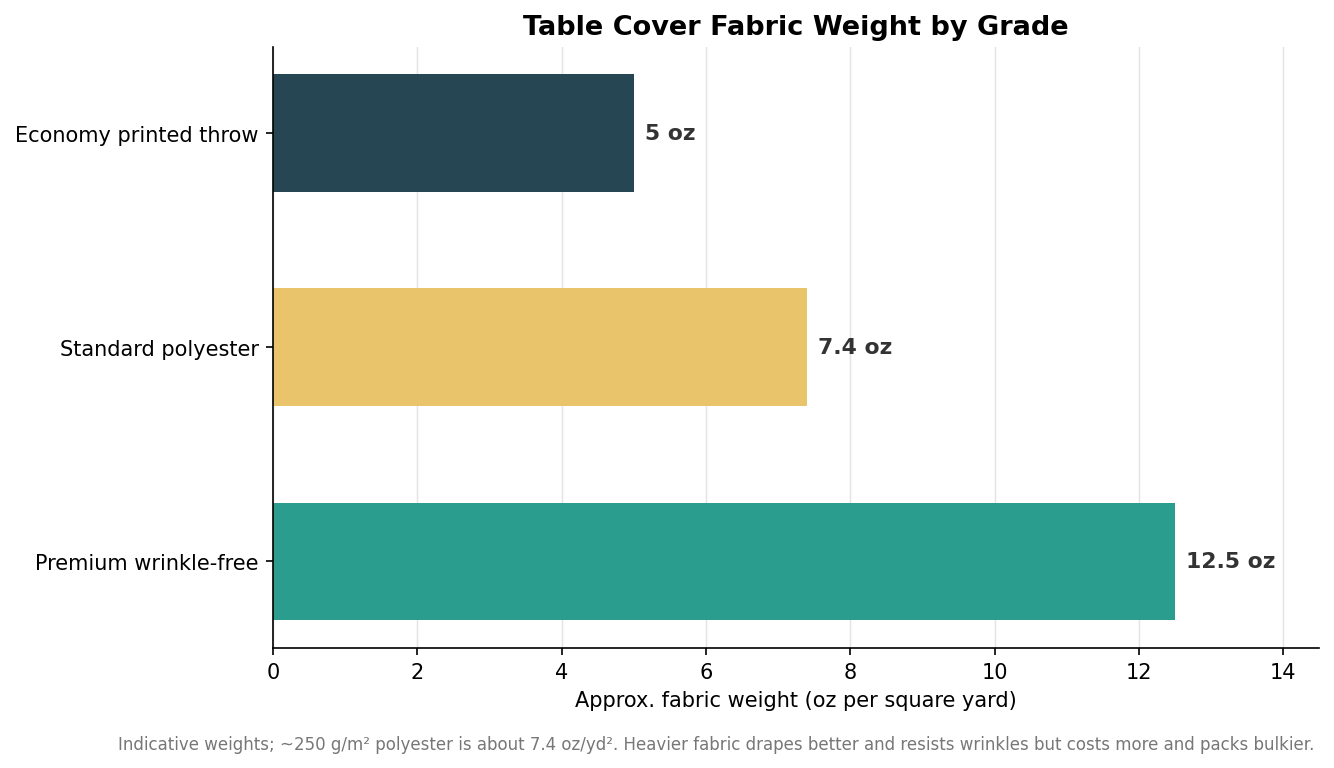
Covers are almost always polyester, but the weight varies and it is worth asking about. Economy printed throws run around 5 ounces per square yard, mid-grade fabric sits near 7.4 ounces, roughly the 250 grams-per-square-meter common in the trade, and premium wrinkle-free fabrics climb to about 12.5 ounces. Heavier fabric hangs better, resists wrinkles, and feels more substantial, at the cost of a higher price and a bulkier, heavier packed cover to ship and carry.
Full-color graphics are applied by dye sublimation, which fuses the ink into the polyester under heat and pressure, roughly 400 degrees Fahrenheit and 400 psi, for a durable, photo-quality print that will not crack or peel and survives repeated washing. Most covers are machine washable on a gentle, cold or warm cycle with mild detergent, tumble dried low or air-dried, and any wrinkles steam out easily. If your venue requires it, order fabric certified flame retardant to NFPA 701; many convention centers ask for that certification, and it is a fabric-level choice you make when you order rather than something you can add later.
Putting the order together
Start from where the table sits and how often the size changes: that tells you open versus closed back and throw versus fitted or stretch. Confirm the exact table dimensions before committing to a fitted or stretch cut. Choose a fabric weight that matches how the cover will be used, leaning heavier for a permanent showroom piece and lighter for something you fly with often. Specify dye-sublimated full-color print, the panels that carry your artwork, and flame-retardant certification if the venue demands it. Get those decisions down before you approve the proof, and the cover that arrives will fit the table, survive the travel and washing, and make the booth look deliberately put together rather than draped in an afterthought.