Two decisions do most of the work on a custom tablecloth: how the graphic gets onto the fabric, and which fabric it lands on. Get those right and the cloth looks sharp under booth lighting, survives a season of events, and arrives on time. Get them wrong and you end up with a logo that cracks after three washes or a color that reads orange instead of brand red. This guide walks through the print methods, the common fabrics, how to size the throw to your table, and how turnaround and quantity affect your order.
How custom tablecloths are printed
Dye sublimation is the standard for full-color work. A four-color CMYK image is printed to transfer paper, then heat turns the ink to gas so it bonds into the polyester fibers themselves. Because the dye becomes part of the cloth, the print is permanent, does not peel or crack, and stays smooth to the touch. It reproduces photographs, gradients, and edge-to-edge coverage cleanly, and it is economical even at a quantity of one. The two catches: it only works on polyester, and because it is a CMYK process it cannot reproduce true metallic inks.
Screen printing is the traditional textile method. A stencil screen is burned for each color and ink is pushed through it, which makes it excellent for one or two solid spot colors and crisp lettering. Each additional color means another screen and another setup charge, so cost climbs fast with a complex design. Screen printing tends to make sense at roughly a dozen pieces or more per logo, which is why hotels, restaurants, and large corporate orders often use it for simple marks.
Heat transfer and cut vinyl apply a pre-printed or cut film onto the surface of the fabric with a heat press. It is workable for a single spot logo in very small quantities, but the graphic sits on top of the cloth rather than in it, so it can crack or lift over time and after repeated laundering. For anything you plan to reuse heavily, treat heat transfer as the budget option for a one-off rather than a durable finish.
Matching the method to your artwork
Let the design pick the method. A photographic background, a gradient, or more than two colors points squarely to dye sublimation, where color count has no effect on price. A single bold logo in one or two exact spot colors, ordered in a dozen or more, is a natural fit for screen printing. A lone logo in one or two pieces on a tight budget is the narrow case where heat transfer earns its place.
Brand color matters here. Dye sublimation is a CMYK process, so a specific Pantone target is matched as closely as the gamut allows rather than guaranteed exactly, and metallics and neons are approximations. Supply coated (solid coated) PMS references, and if a brand color is critical, ask for a physical strike-off or fabric proof before the full run rather than trusting an on-screen preview. Send vector art (.AI, .EPS, or press-ready PDF) with the text converted to outlines so nothing reflows, and if you must use a raster file, build it at full size and 300 dpi with bleed on every edge.
Choosing the fabric
The workhorse is 5 oz polyester poplin: color-fast, wrinkle-resistant though not wrinkle-free, widely available with NFPA 701 flame-retardant certification, and a good match for dye sublimation. Spun polyester trades a little crispness for a softer, more linen-like drape, which suits banquet and hospitality settings. 300D polyester is tightly woven with a matte finish that photographs well at trade shows, while 600D polyester with a polyurethane coating is heavier and water-resistant for outdoor festivals and food service. Stretch (spandex) fabric pulls tight over the frame for a wrinkle-free, modern look and packs down small for traveling reps.
If your event is in a convention center, hotel ballroom, or school, ask whether NFPA 701 certification is required before you order; many venues and trade-show halls mandate it, and you will want the certificate on file. Flame-retardant polyester is inherently rated rather than chemically treated, so the rating does not wash out over the life of the cloth.
Sizing the throw to the table
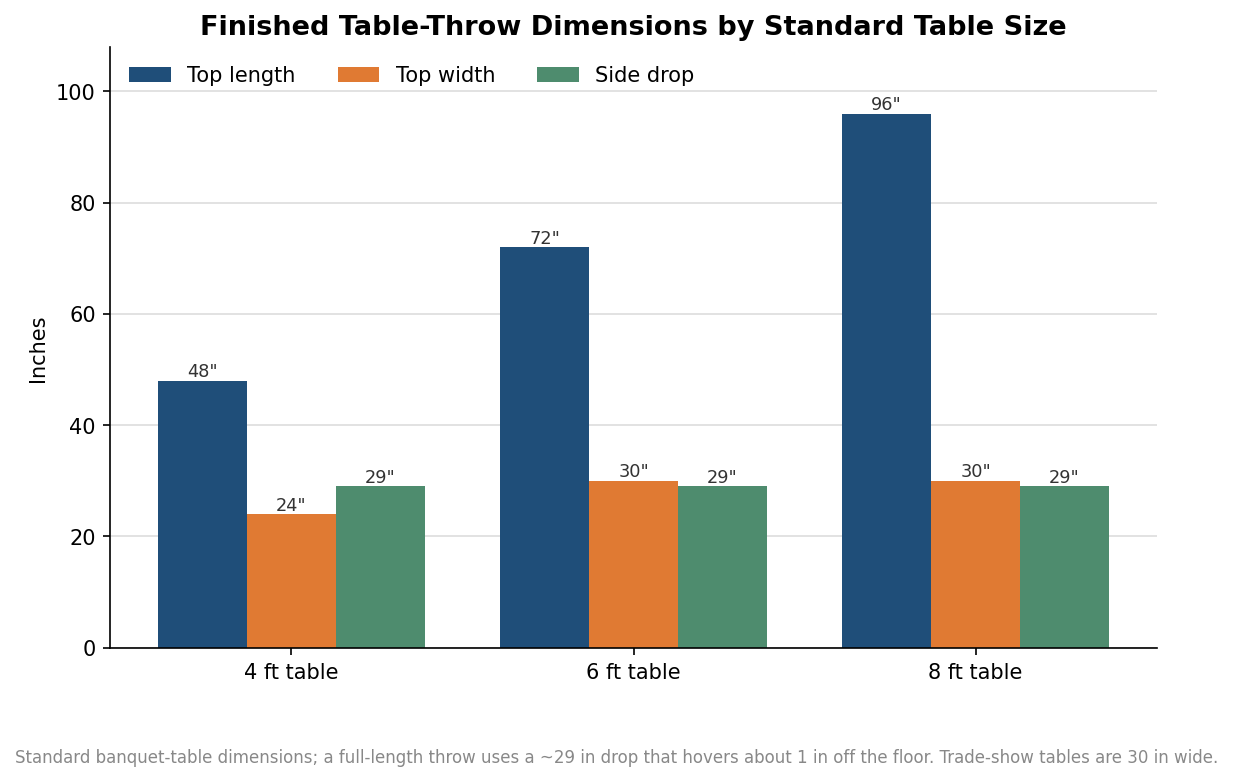
Standard folding banquet tables come in 4-, 6-, and 8-foot lengths, and their tops are a predictable set of dimensions: about 48 by 24 inches for the 4-foot, 72 by 30 inches for the 6-foot, and 96 by 30 inches for the 8-foot, all roughly 29 to 30 inches high. A full-length, closed-back throw drapes on all four sides with about a 29-inch drop so the hem hovers roughly an inch off the floor. An open-back throw leaves the rear panel open for seating, storage, or a cash box, while fitted and stretch styles hug the table for a tailored profile. If you rotate between table sizes, a convertible 6-to-8-foot throw covers both. Measure the top length, the top width, and the height, and add the drop you want before you commit to a size.
Turnaround, quantity, and cost
Standard production runs about 2 weeks after you approve the proof, and the free mockup comes back within 24 hours. If an event date is tight, ask about express turnaround, which is available on request but is not the standard timeline. Build in a few days for shipping on top of production.
What drives the price of a custom tablecloth is the table size, the fabric, the print method and the quantity, with the minimum order starting at 12 cloths. Volume brings the per-cloth cost down, and the quickest way to see where your order lands is to request a quote with your artwork and quantity. The economics of the print methods matter as much as the sticker price: dye sublimation carries no per-color penalty, so a ten-color design costs the same to print as a one-color one, whereas screen printing adds a setup charge per color and generally wants a minimum around a dozen pieces. For most single-table promotional throws with a colorful design, dye-sublimated polyester poplin sized to your table with a full drop is the safe default; step up to 600D or stretch fabric only when the venue or the look calls for it.