A custom tablecloth is one of the few booth or event purchases where a small spec error is impossible to hide. The logo is printed, the fabric is cut, and if the drop is wrong or the cover is the wrong length, you find out in front of customers with no time to fix it. The good news is that almost every expensive tablecloth mistake comes from the same handful of misunderstandings about size, drop and certification. Here are the ones worth designing out before you approve a proof.
Assuming a 6-foot and 8-foot cover are interchangeable
The most common and most costly error is treating table length loosely. A standard banquet table is either 72 inches long (6 foot) or 96 inches long (8 foot), both about 30 inches tall, and a fitted cover is sewn to one of those exact footprints. A 6-foot fitted cover simply will not stretch over an 8-foot table, and an 8-foot fitted cover on a 6-foot table sags and bunches at the corners. If you genuinely need one cover to serve both, a draped throw is the size-tolerant choice because it hangs loose rather than tailoring to the frame, but you trade away the crisp, structured look. Decide which table you are covering first, confirm the actual dimensions of the tables your venue supplies rather than assuming, and only then choose between fitted, throw and stretch. It is also worth checking whether the venue provides 4-foot tables for registration or side displays, which are 48 inches long and take a different cover again; a cover sized for the main 6-foot table will hang past the ends of a 4-foot one.
Ordering the wrong drop length
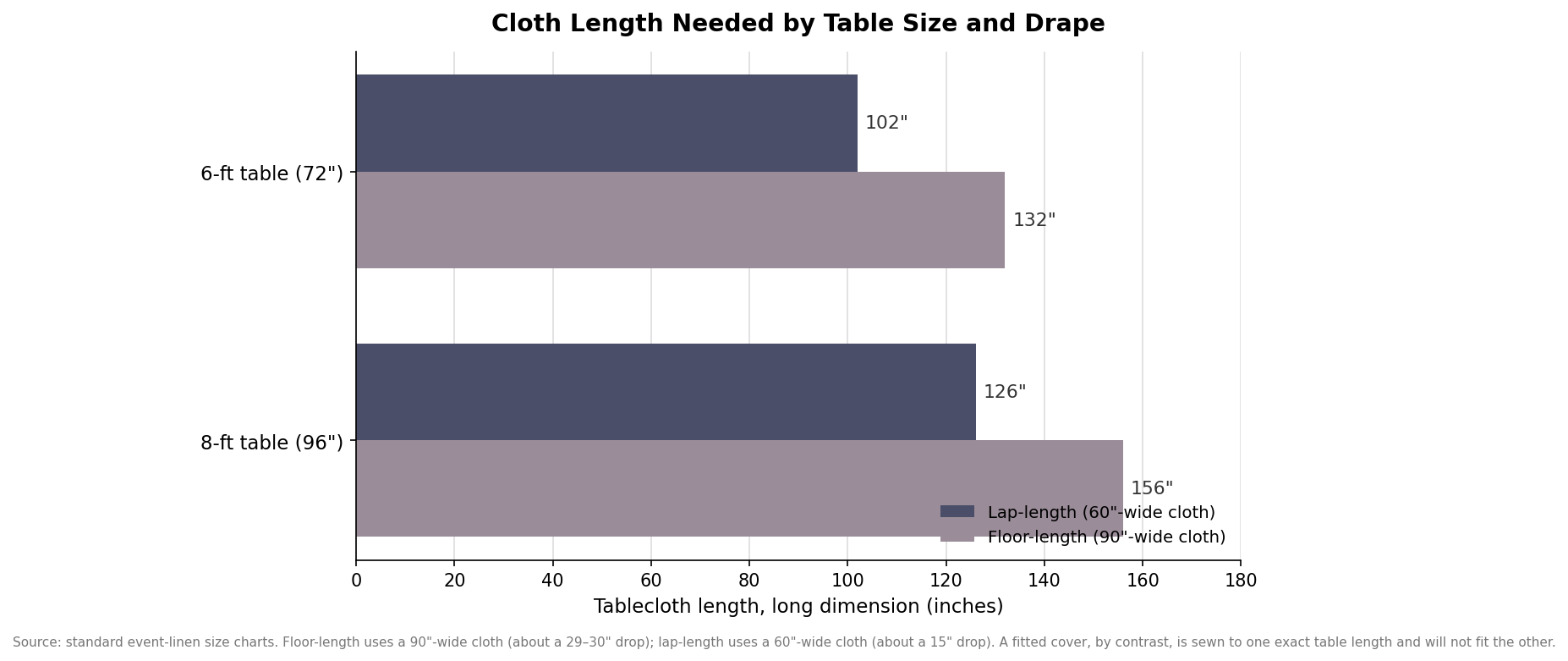
Even with the right table, buyers routinely order the wrong amount of overhang. A floor-length look on a 6-foot table needs a cloth roughly 90 by 132 inches, which gives about a 29 to 30 inch drop to the floor on the sides; the 8-foot equivalent is about 90 by 156 inches. A lap-length cloth, which stops around 15 inches down and leaves the legs visible, is a different size entirely, roughly 60 by 102 inches for a 6-foot table and 60 by 126 for an 8-foot. People order the lap-length size expecting the fabric to reach the floor, or buy floor-length and find it pooling on the ground. Pick the drape you want, then match the cloth dimensions to it rather than eyeballing the picture.
Forgetting that cocktail tables are taller
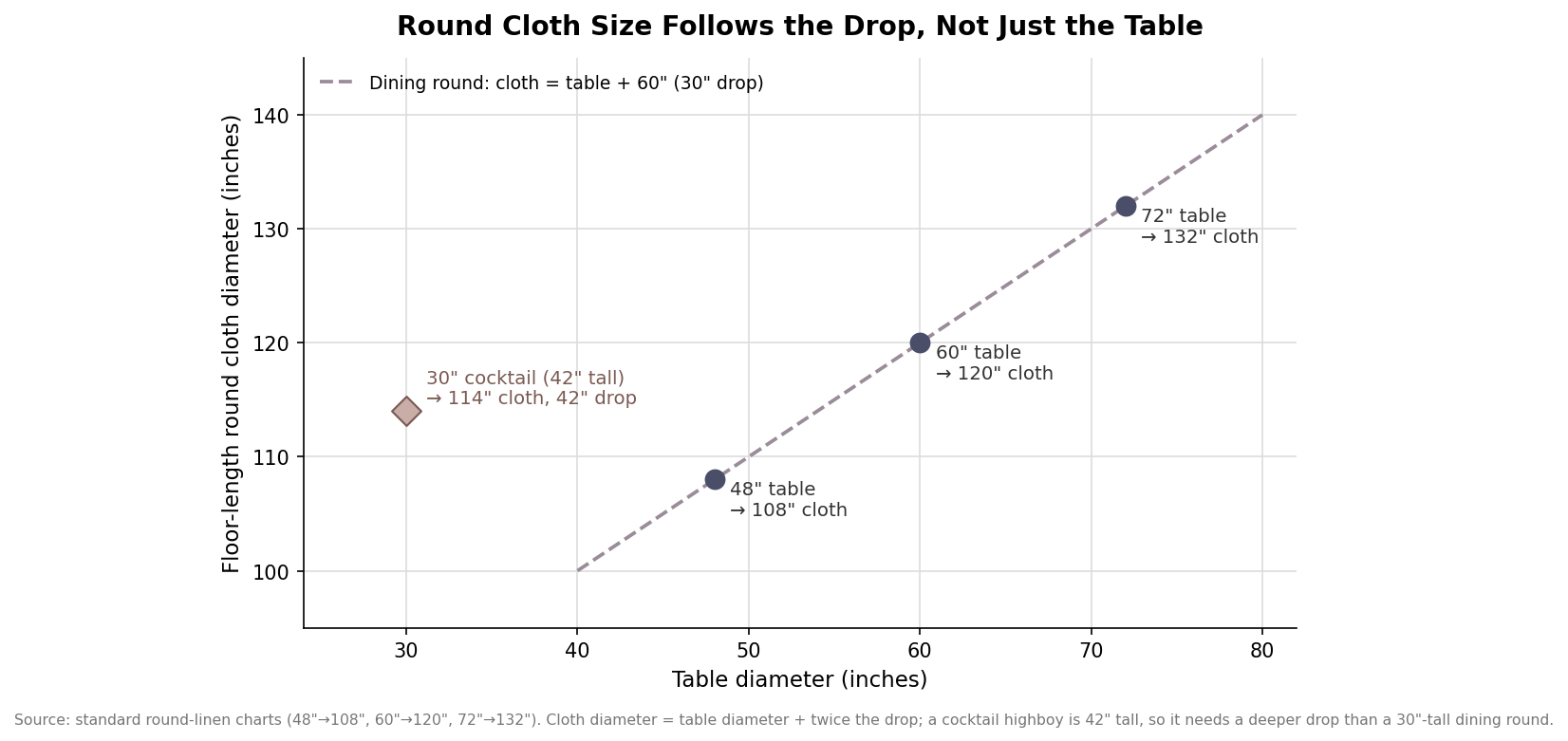
Highboy cocktail tables trip up otherwise careful buyers because they are 42 inches tall instead of the 30 inches of a dining or banquet table. A round cloth sized to reach the floor on a 60-inch dining table will float well above the floor on a 30-inch cocktail table, because the cloth diameter has to account for twice the drop, not just the tabletop. The rule that ties it together is simple: the finished cloth diameter equals the table diameter plus twice the drop to the floor. A 48-inch dining round takes a 108-inch cloth, a 60-inch takes 120, and a 72-inch takes 132, all at a 30-inch drop, while a 30-inch cocktail table needs about a 114-inch cloth to cover its taller 42-inch drop. Ordering a “standard” round without checking the table height is how you end up with a stubby cover at a networking reception.
Skipping the flame-retardant certification
This is the mistake that gets a booth shut down rather than just looking off. Many convention centers and public-assembly venues require table linens to meet the NFPA 701 flame-propagation test. It is a national testing standard rather than a federal law, but state and local fire codes frequently reference it, and a fire marshal doing a setup inspection can pull noncompliant fabric off your table before the doors open. Certified flame-retardant polyester looks identical to the non-certified version, so the only way to know you have it is to specify it on the order and keep the certificate handy. Check your venue’s exhibitor rules before you buy, and if flame certification is required, make it a non-negotiable line on the spec rather than an upgrade you skip to cut corners.
Underspecifying the fabric and the color
Two quieter mistakes round out the list. The first is choosing a fabric too light for the job, so the table edge or a dark tabletop ghosts through a light-colored print and the whole cover looks cheap; a heavier, opaque polyester avoids that and also drapes better. The second is expecting an exact brand-color match from dye sublimation, which is the standard process for full-color printed polyester. Sublimation reproduces color well but not perfectly, and a specific Pantone in your logo can shift slightly on fabric compared with how it looks on coated paper or a screen. For anything brand-critical, ask for a printed fabric strike-off or sample swatch before committing to a full run, and confirm the fabric weight rather than accepting whatever the base quote assumes. Plan for the practical side too: printed polyester packs down small and travels well, but it does not arrive at the booth crease-free, so a portable steamer and a few minutes of setup time are the difference between a sharp table and a wrinkled one. If you reorder later, keep a record of the exact fabric and print file used, because a second batch run months apart on a slightly different fabric lot can shift just enough to be noticeable side by side.
None of these require special expertise, only a habit of writing the full specification down: table size and height, the drape you want with the matching cloth dimensions, fitted versus throw versus stretch, flame certification if the venue needs it, and a confirmed fabric weight and color proof. The dimensions here follow standard event-linen sizing and are a reliable starting point, though individual suppliers round differently, so verify the exact cut sizes and any certification requirement against your specific tables and venue before you approve the order.