Get Custom Tablecloths

Category: Uncategorized

  • Six Costly Mistakes When Ordering Custom Event Tablecloths

    Six Costly Mistakes When Ordering Custom Event Tablecloths

    A custom tablecloth is one of the few booth or event purchases where a small spec error is impossible to hide. The logo is printed, the fabric is cut, and if the drop is wrong or the cover is the wrong length, you find out in front of customers with no time to fix it. The good news is that almost every expensive tablecloth mistake comes from the same handful of misunderstandings about size, drop and certification. Here are the ones worth designing out before you approve a proof.

    Assuming a 6-foot and 8-foot cover are interchangeable

    The most common and most costly error is treating table length loosely. A standard banquet table is either 72 inches long (6 foot) or 96 inches long (8 foot), both about 30 inches tall, and a fitted cover is sewn to one of those exact footprints. A 6-foot fitted cover simply will not stretch over an 8-foot table, and an 8-foot fitted cover on a 6-foot table sags and bunches at the corners. If you genuinely need one cover to serve both, a draped throw is the size-tolerant choice because it hangs loose rather than tailoring to the frame, but you trade away the crisp, structured look. Decide which table you are covering first, confirm the actual dimensions of the tables your venue supplies rather than assuming, and only then choose between fitted, throw and stretch. It is also worth checking whether the venue provides 4-foot tables for registration or side displays, which are 48 inches long and take a different cover again; a cover sized for the main 6-foot table will hang past the ends of a 4-foot one.

    Ordering the wrong drop length

    Even with the right table, buyers routinely order the wrong amount of overhang. A floor-length look on a 6-foot table needs a cloth roughly 90 by 132 inches, which gives about a 29 to 30 inch drop to the floor on the sides; the 8-foot equivalent is about 90 by 156 inches. A lap-length cloth, which stops around 15 inches down and leaves the legs visible, is a different size entirely, roughly 60 by 102 inches for a 6-foot table and 60 by 126 for an 8-foot. People order the lap-length size expecting the fabric to reach the floor, or buy floor-length and find it pooling on the ground. Pick the drape you want, then match the cloth dimensions to it rather than eyeballing the picture.
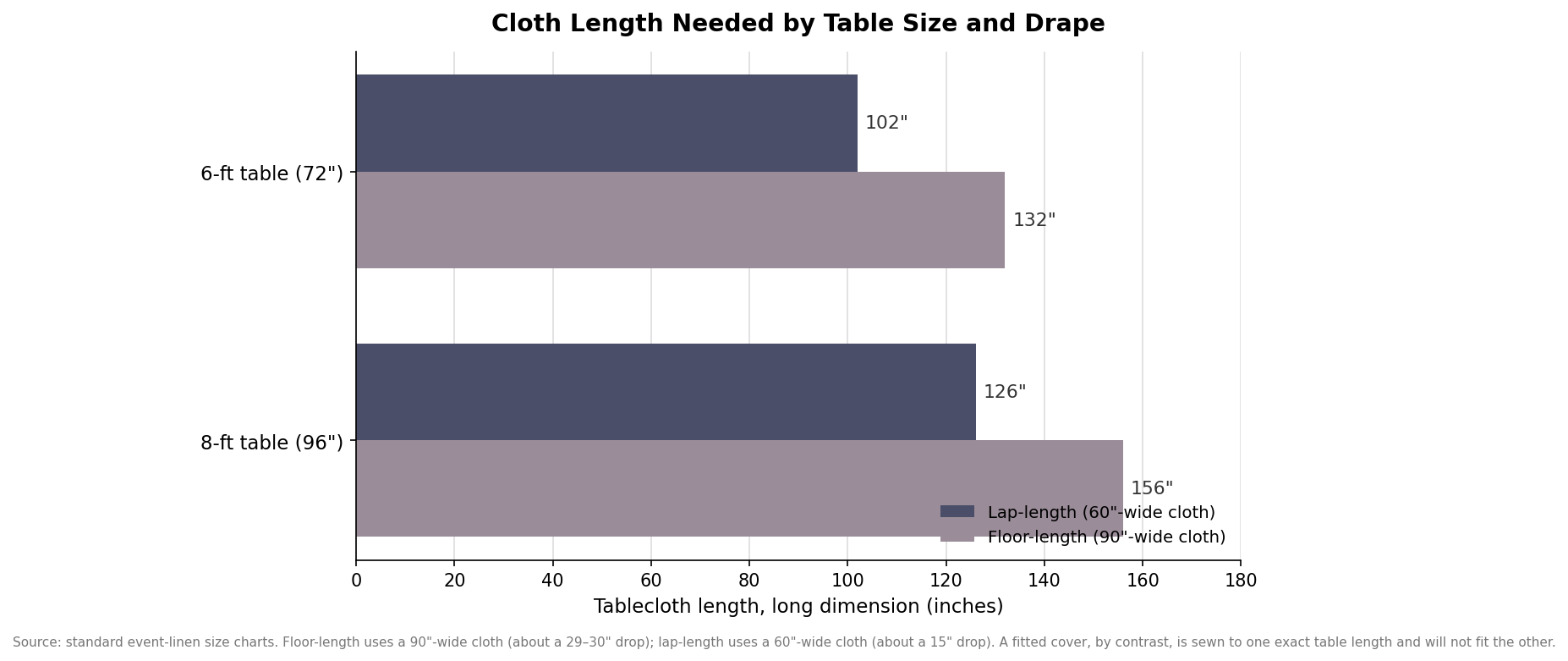
    Grouped horizontal bar chart of tablecloth length by table size and drape: 6-foot table needs 102 inches lap or 132 inches floor-length; 8-foot table needs 126 or 156 inches
    Floor-length and lap-length cloths are different sizes; match the cloth to the drape you want.

    Forgetting that cocktail tables are taller

    Highboy cocktail tables trip up otherwise careful buyers because they are 42 inches tall instead of the 30 inches of a dining or banquet table. A round cloth sized to reach the floor on a 60-inch dining table will float well above the floor on a 30-inch cocktail table, because the cloth diameter has to account for twice the drop, not just the tabletop. The rule that ties it together is simple: the finished cloth diameter equals the table diameter plus twice the drop to the floor. A 48-inch dining round takes a 108-inch cloth, a 60-inch takes 120, and a 72-inch takes 132, all at a 30-inch drop, while a 30-inch cocktail table needs about a 114-inch cloth to cover its taller 42-inch drop. Ordering a “standard” round without checking the table height is how you end up with a stubby cover at a networking reception.
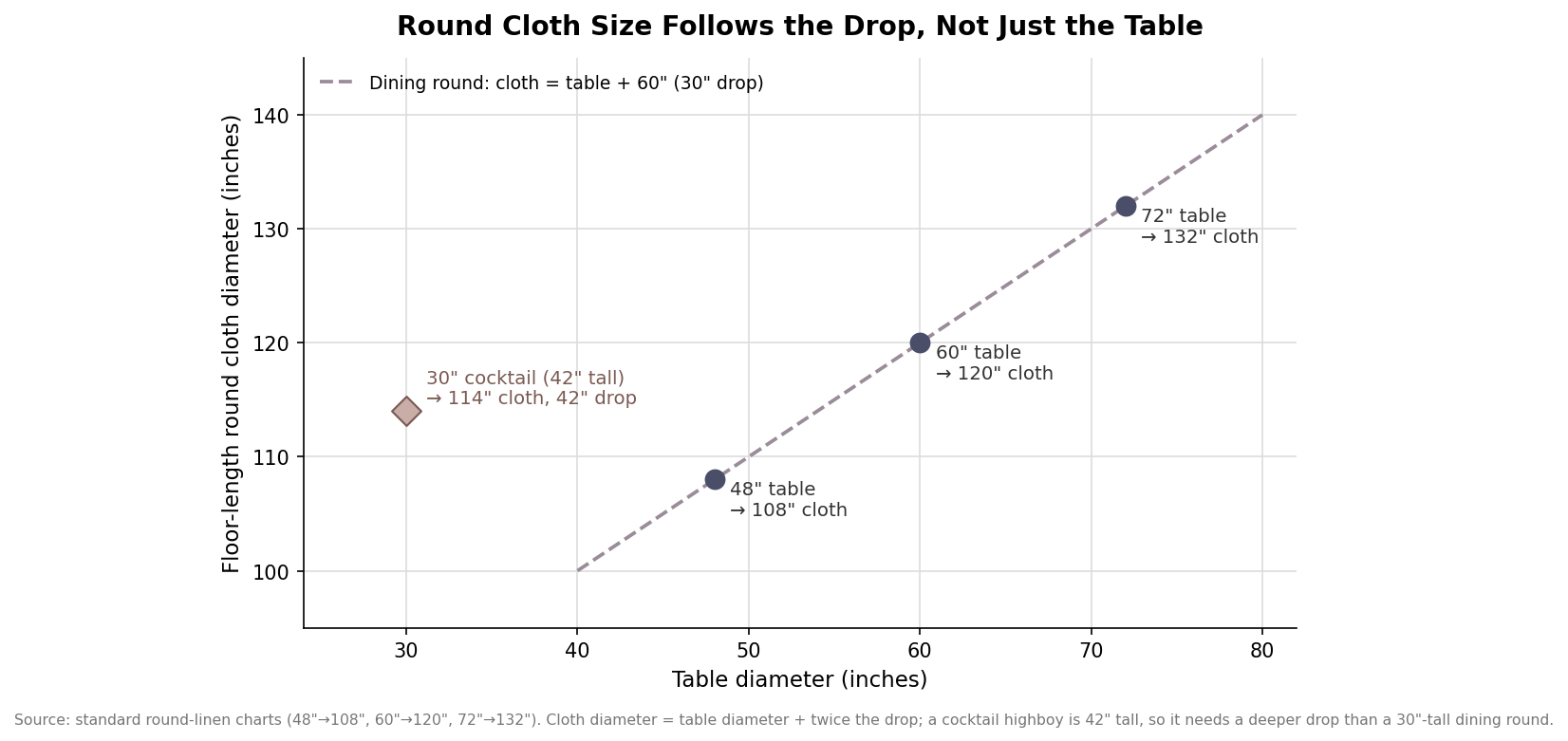
    Scatter chart showing round cloth diameter equals table diameter plus twice the drop, with a 30-inch cocktail table needing a 114-inch cloth because it is 42 inches tall
    Round cloth size tracks the drop to the floor, so a taller cocktail table needs a bigger cloth than its small top suggests.

    Skipping the flame-retardant certification

    This is the mistake that gets a booth shut down rather than just looking off. Many convention centers and public-assembly venues require table linens to meet the NFPA 701 flame-propagation test. It is a national testing standard rather than a federal law, but state and local fire codes frequently reference it, and a fire marshal doing a setup inspection can pull noncompliant fabric off your table before the doors open. Certified flame-retardant polyester looks identical to the non-certified version, so the only way to know you have it is to specify it on the order and keep the certificate handy. Check your venue’s exhibitor rules before you buy, and if flame certification is required, make it a non-negotiable line on the spec rather than an upgrade you skip to cut corners.

    Underspecifying the fabric and the color

    Two quieter mistakes round out the list. The first is choosing a fabric too light for the job, so the table edge or a dark tabletop ghosts through a light-colored print and the whole cover looks cheap; a heavier, opaque polyester avoids that and also drapes better. The second is expecting an exact brand-color match from dye sublimation, which is the standard process for full-color printed polyester. Sublimation reproduces color well but not perfectly, and a specific Pantone in your logo can shift slightly on fabric compared with how it looks on coated paper or a screen. For anything brand-critical, ask for a printed fabric strike-off or sample swatch before committing to a full run, and confirm the fabric weight rather than accepting whatever the base quote assumes. Plan for the practical side too: printed polyester packs down small and travels well, but it does not arrive at the booth crease-free, so a portable steamer and a few minutes of setup time are the difference between a sharp table and a wrinkled one. If you reorder later, keep a record of the exact fabric and print file used, because a second batch run months apart on a slightly different fabric lot can shift just enough to be noticeable side by side.

    None of these require special expertise, only a habit of writing the full specification down: table size and height, the drape you want with the matching cloth dimensions, fitted versus throw versus stretch, flame certification if the venue needs it, and a confirmed fabric weight and color proof. The dimensions here follow standard event-linen sizing and are a reliable starting point, though individual suppliers round differently, so verify the exact cut sizes and any certification requirement against your specific tables and venue before you approve the order.
  • Print Methods and Fabrics for Custom Tablecloths: What to Specify Before You Order

    Print Methods and Fabrics for Custom Tablecloths: What to Specify Before You Order

    Two decisions do most of the work on a custom tablecloth: how the graphic gets onto the fabric, and which fabric it lands on. Get those right and the cloth looks sharp under booth lighting, survives a season of events, and arrives on time. Get them wrong and you end up with a logo that cracks after three washes or a color that reads orange instead of brand red. This guide walks through the print methods, the common fabrics, how to size the throw to your table, and how turnaround and quantity affect your order.

    How custom tablecloths are printed

    Dye sublimation is the standard for full-color work. A four-color CMYK image is printed to transfer paper, then heat turns the ink to gas so it bonds into the polyester fibers themselves. Because the dye becomes part of the cloth, the print is permanent, does not peel or crack, and stays smooth to the touch. It reproduces photographs, gradients, and edge-to-edge coverage cleanly, and it is economical even at a quantity of one. The two catches: it only works on polyester, and because it is a CMYK process it cannot reproduce true metallic inks.

    Screen printing is the traditional textile method. A stencil screen is burned for each color and ink is pushed through it, which makes it excellent for one or two solid spot colors and crisp lettering. Each additional color means another screen and another setup charge, so cost climbs fast with a complex design. Screen printing tends to make sense at roughly a dozen pieces or more per logo, which is why hotels, restaurants, and large corporate orders often use it for simple marks.

    Heat transfer and cut vinyl apply a pre-printed or cut film onto the surface of the fabric with a heat press. It is workable for a single spot logo in very small quantities, but the graphic sits on top of the cloth rather than in it, so it can crack or lift over time and after repeated laundering. For anything you plan to reuse heavily, treat heat transfer as the budget option for a one-off rather than a durable finish.

    Matching the method to your artwork

    Let the design pick the method. A photographic background, a gradient, or more than two colors points squarely to dye sublimation, where color count has no effect on price. A single bold logo in one or two exact spot colors, ordered in a dozen or more, is a natural fit for screen printing. A lone logo in one or two pieces on a tight budget is the narrow case where heat transfer earns its place.

    Brand color matters here. Dye sublimation is a CMYK process, so a specific Pantone target is matched as closely as the gamut allows rather than guaranteed exactly, and metallics and neons are approximations. Supply coated (solid coated) PMS references, and if a brand color is critical, ask for a physical strike-off or fabric proof before the full run rather than trusting an on-screen preview. Send vector art (.AI, .EPS, or press-ready PDF) with the text converted to outlines so nothing reflows, and if you must use a raster file, build it at full size and 300 dpi with bleed on every edge.

    Choosing the fabric

    The workhorse is 5 oz polyester poplin: color-fast, wrinkle-resistant though not wrinkle-free, widely available with NFPA 701 flame-retardant certification, and a good match for dye sublimation. Spun polyester trades a little crispness for a softer, more linen-like drape, which suits banquet and hospitality settings. 300D polyester is tightly woven with a matte finish that photographs well at trade shows, while 600D polyester with a polyurethane coating is heavier and water-resistant for outdoor festivals and food service. Stretch (spandex) fabric pulls tight over the frame for a wrinkle-free, modern look and packs down small for traveling reps.

    If your event is in a convention center, hotel ballroom, or school, ask whether NFPA 701 certification is required before you order; many venues and trade-show halls mandate it, and you will want the certificate on file. Flame-retardant polyester is inherently rated rather than chemically treated, so the rating does not wash out over the life of the cloth.

    Sizing the throw to the table

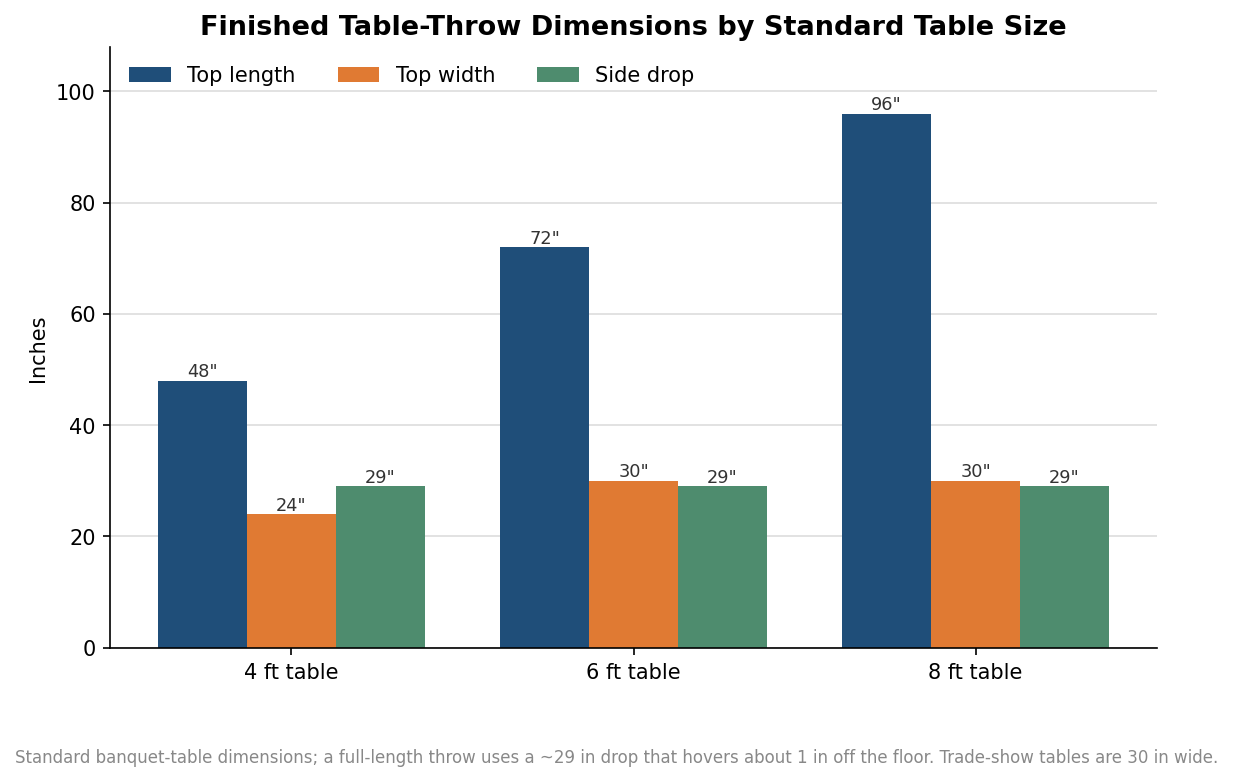
    Grouped bar chart of finished table-throw dimensions for 4-, 6-, and 8-foot tables in inches
    Top length grows with table size while top width and side drop stay constant across standard banquet tables.

    Standard folding banquet tables come in 4-, 6-, and 8-foot lengths, and their tops are a predictable set of dimensions: about 48 by 24 inches for the 4-foot, 72 by 30 inches for the 6-foot, and 96 by 30 inches for the 8-foot, all roughly 29 to 30 inches high. A full-length, closed-back throw drapes on all four sides with about a 29-inch drop so the hem hovers roughly an inch off the floor. An open-back throw leaves the rear panel open for seating, storage, or a cash box, while fitted and stretch styles hug the table for a tailored profile. If you rotate between table sizes, a convertible 6-to-8-foot throw covers both. Measure the top length, the top width, and the height, and add the drop you want before you commit to a size.

    Turnaround, quantity, and cost

    Standard production runs about 2 weeks after you approve the proof, and the free mockup comes back within 24 hours. If an event date is tight, ask about express turnaround, which is available on request but is not the standard timeline. Build in a few days for shipping on top of production.

    What drives the price of a custom tablecloth is the table size, the fabric, the print method and the quantity, with the minimum order starting at 12 cloths. Volume brings the per-cloth cost down, and the quickest way to see where your order lands is to request a quote with your artwork and quantity. The economics of the print methods matter as much as the sticker price: dye sublimation carries no per-color penalty, so a ten-color design costs the same to print as a one-color one, whereas screen printing adds a setup charge per color and generally wants a minimum around a dozen pieces. For most single-table promotional throws with a colorful design, dye-sublimated polyester poplin sized to your table with a full drop is the safe default; step up to 600D or stretch fabric only when the venue or the look calls for it.

  • Trade Show Table Cover Styles: Throw, Fitted or Stretch (and Open vs Closed Back)

    Trade Show Table Cover Styles: Throw, Fitted or Stretch (and Open vs Closed Back)

    Two booths at the same show can run the same logo on their table and still look a class apart, and the reason is usually the cover style rather than the print. A loose throw, a tailored fitted cover, and a form-hugging stretch cover read very differently across an aisle, fit different tables, and cost different amounts. Picking the wrong one means either fabric pooling on the floor or a cover that will not go over your table at all. Here is how the three styles differ and how to match one to your table and your booth.

    The three cover styles at a glance

    The throw, sometimes called a draped or economy cover, is a single panel that lays over the table and drapes toward the floor. It is the most affordable style and the most forgiving of slight size differences, so one throw can work across 4, 6, and 8 foot tables. The trade-off is a looser look, with excess fabric that can bunch at the corners and pool on the floor. The fitted cover is sewn to a box shape with tailored corners and sharp vertical edges, giving a clean, professional line and no loose fabric, but it is cut for one specific table size and will not interchange. The stretch cover, made from a spandex-blend fabric, pulls taut over the table and legs for a sleek, modern, wrinkle-free finish; it is the premium option, and because the fabric is under tension, a printed design cannot cleanly cross the seam lines. A printed table runner is a useful companion to any of the three: laid across a solid or lightly branded base cover, it adds a second graphic surface and lets you refresh messaging for a new show without reordering the whole cover.

    Open back or closed back: the decision people forget

    Independently of style, most covers come in a three-sided (open back) or four-sided (closed back) configuration, and this choice matters as much as the style. An open back leaves the rear panel off, so your staff can sit behind the table, tuck their legs under, and store boxes and cases out of sight beneath it. That is the right pick when the table sits against a booth wall and only three sides ever face the public. A closed back wraps all four sides and fully encloses the table, which you want when the table stands as a freestanding island that attendees can walk around, or when you want everything underneath completely hidden. Throw and fitted styles offer both backs; stretch covers are typically open-back by design. Decide this based on where the table physically sits in the booth, not on looks alone.

    Match the style to the table and the booth

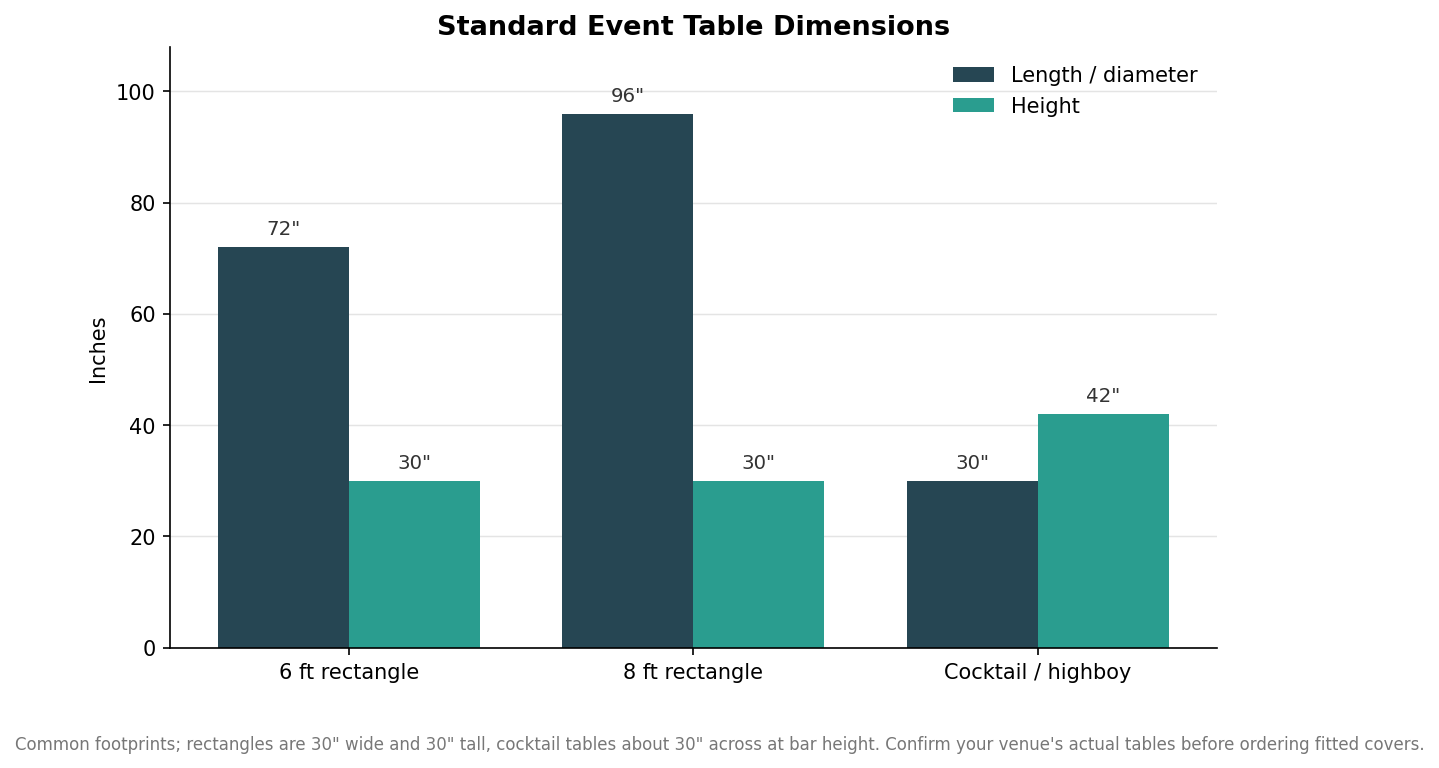
    Fitted and stretch covers are cut to a specific table, so you have to know the exact table before you order. The two rectangular sizes that dominate trade shows are the 6 foot table at 72 by 30 by 30 inches and the 8 foot table at 96 by 30 by 30 inches; cocktail or highboy tables are round, roughly 30 inches across and 42 inches tall at bar height. The chart below lays these out so you can confirm which cover size you actually need.

    Grouped bar chart of standard event table dimensions, length or diameter versus height, for 6ft, 8ft and cocktail tables
    Standard trade-show table footprints; fitted and stretch covers must match these exactly.

    If you travel to venues that supply different tables, a throw is the safer buy because it tolerates small size differences, while a fitted or stretch cover locks you to one footprint. When you control the table, or always rent the same size, the tailored styles reward you with a sharper look. Convertible throws that adjust between 6 and 8 feet exist as a middle path if you regularly face both.

    Fabric weight, printing and care

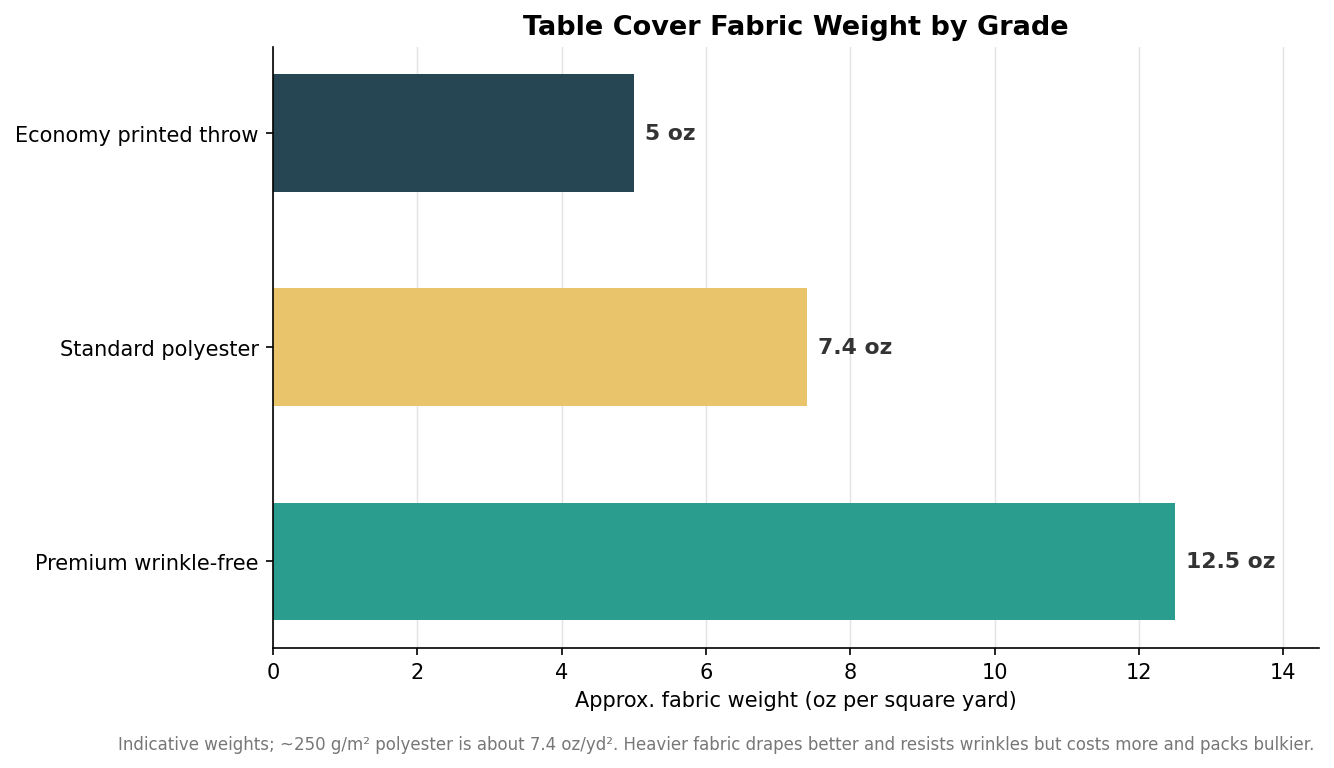
    Covers are almost always polyester, but the weight varies and it is worth asking about. Economy printed throws run around 5 ounces per square yard, mid-grade fabric sits near 7.4 ounces, roughly the 250 grams-per-square-meter common in the trade, and premium wrinkle-free fabrics climb to about 12.5 ounces. Heavier fabric hangs better, resists wrinkles, and feels more substantial, at the cost of a higher price and a bulkier, heavier packed cover to ship and carry.

    Horizontal bar chart of table cover fabric weight in ounces per square yard by grade
    Heavier polyester drapes better and resists wrinkles but costs more and packs bulkier.

    Full-color graphics are applied by dye sublimation, which fuses the ink into the polyester under heat and pressure, roughly 400 degrees Fahrenheit and 400 psi, for a durable, photo-quality print that will not crack or peel and survives repeated washing. Most covers are machine washable on a gentle, cold or warm cycle with mild detergent, tumble dried low or air-dried, and any wrinkles steam out easily. If your venue requires it, order fabric certified flame retardant to NFPA 701; many convention centers ask for that certification, and it is a fabric-level choice you make when you order rather than something you can add later.

    Putting the order together

    Start from where the table sits and how often the size changes: that tells you open versus closed back and throw versus fitted or stretch. Confirm the exact table dimensions before committing to a fitted or stretch cut. Choose a fabric weight that matches how the cover will be used, leaning heavier for a permanent showroom piece and lighter for something you fly with often. Specify dye-sublimated full-color print, the panels that carry your artwork, and flame-retardant certification if the venue demands it. Get those decisions down before you approve the proof, and the cover that arrives will fit the table, survive the travel and washing, and make the booth look deliberately put together rather than draped in an afterthought.

  • How to Measure a Table for a Tablecloth

    Almost every fit complaint in this category traces back to a dimension somebody took from a brochure rather than a tape measure.

    Measure the actual table

    Length, width and height for a rectangular table; diameter and height for a round one. Take them from the table you will have on the day.

    Trestle heights vary by a few centimeters between hire companies and poseur diameters vary more. On a fitted cloth those centimeters are the difference between crisp and baggy.

    Then decide the drop

    The drop is how far the cloth hangs below the table edge. Full drop means it just clears the floor, which hides legs and storage. A mid drop of roughly half the table height suits buffets and working tables.

    Cut size is table dimension plus twice the drop, plus hem. We do that arithmetic and put the result on the quote so it can be checked.

    Fitted cloths need the height most

    A draped cloth forgives a centimeter or two because the excess simply hangs. A fitted throw or a stretch cover does not: the height determines where the seam sits, and a seam in the wrong place is obvious.

    If you are ordering fitted linen for tables you have not seen, ask the venue to measure one and send the numbers.

    Write the sizes down

    Record the dimensions and which cloth went to which table. For a venue or a hire company this turns every reorder into a spreadsheet rather than an afternoon with a tape.

    We keep your dimensions on file too, so a repeat order is one line of email.

  • The Complete Buyer’s Guide to Custom Tablecloths

    Table linen is bought on a picture and judged on how it hangs. These four decisions are what decide the second part.

    Format follows the room

    Fitted throws for exhibitions: cut to the table, square all day, three-sided so staff can sit and store boxes underneath. Stretch spandex for stages and anything on camera, because tension pulls every crease and shadow out of the surface.

    Draped cloths for banqueting and weddings, where a soft hang is the point. And runners where the venue insists on its own linen, which is more often than people expect.

    The drop is the specification

    A cloth is sized from the table dimensions plus how far it must hang. Full to the floor hides legs, cables and boxes and reads formal. A mid drop suits a working or buffet table where people stand close.

    Get the drop wrong in either direction and it is visible from across the room: too short looks like a mistake, too long is a trip hazard and most venues will make you remove it.

    Fabric weight decides whether it hangs or floats

    The most common complaint about event linen is billowing, and it is always the same cause: fabric too light for the room’s airflow. Air conditioning lifts thin polyester all day.

    A heavier weave costs slightly more per cloth and simply hangs. For stretch covers the equivalent question is the spandex content, which is what holds the tension.

    Certification is a document, not an adjective

    If the venue requires flame-retardant linen, it needs a named test standard and a certificate. ‘Fire retardant’ on a quote is not usable.

    Specify inherently flame-retardant fabric rather than treated. A treated coating degrades with laundering, so a compliant cloth quietly becomes a non-compliant one, and nobody re-tests event linen.

    What to send when you ask for a quote

    Table length, width or diameter, and height. The drop you want. Format, quantity, artwork, and whether the venue needs FR certification. That is enough for a real quote and a mockup the same day.

    A throw front is a wide, short canvas, so most logos need repositioning rather than scaling. We redraw free.

  • Flame-Retardant Table Linen, Explained

    Most exhibition halls, theaters and public venues require soft furnishings to meet a flame-retardancy standard. Here is what that means in practice.

    The venue wants a document

    An organizer will ask for the test standard the fabric meets and a certificate to evidence it. A supplier’s word, or the phrase fire retardant on an invoice, does not satisfy that.

    Ask for the paperwork at quote stage rather than the week of the event, when it is too late to change fabric.

    Inherent beats treated, for one specific reason

    Inherently flame-retardant fabric has the property built into the fiber, so it survives laundering. Treated fabric has a coating applied to an ordinary cloth, and that coating degrades every time the cloth is washed.

    Event linen gets laundered and never re-tested, so a treated cloth that complied on delivery may not comply a year later. Nobody finds out until somebody checks.

    It does not make the cloth fireproof

    Flame retardancy slows ignition and limits how a fabric burns. It is a real and useful property and it is not a license to put a candle on the table.

    Venues know this, which is why FR linen sits alongside rules about naked flames rather than replacing them.

    Budget for it early

    FR fabric costs more than standard polyester, and swapping to it late means a reprint rather than a substitution.

    If any of your events are in halls or theaters, it is usually simpler to specify FR across the whole set so that any cloth can go to any venue.